
Pulaski County Busted Mugshots and Records
A mugshot gets taken at booking. The record ties that photo to an arrest date, custody status, physical details, bond figures, and charges. Pulaski County looks simple on paper. In practice, it is indirect. The county's Sheriff Department page sends visitors to an InterOp inmate-information portal, a sheriff-selected vendor rather than a county domain. Follow the chain anyway. It is the published route to official custody data here.
Booking begins with an arrest or another lawful custody event. Jail staff log the person, gather identifying details, and attach a photo when the process produces one. The current roster answers one narrow question: who is booked right now. The date-range view reaches further and can surface records marked released. Match names with care, though. A shared name is common in Georgia. Check the date, agency, court, and other identifiers before assuming two entries describe the same person.
Start at the official Pulaski County Sheriff Department page. It links the roster, offers the jail contact path, and points to state record-restriction information. No gallery lives on this site. The aim is simple. Find the right source, then trace the record to the proper court or custodian.
The official sheriff gateway sits the county jail link right beside local contact details. Trust that chain over a generic search result carrying the same county name.
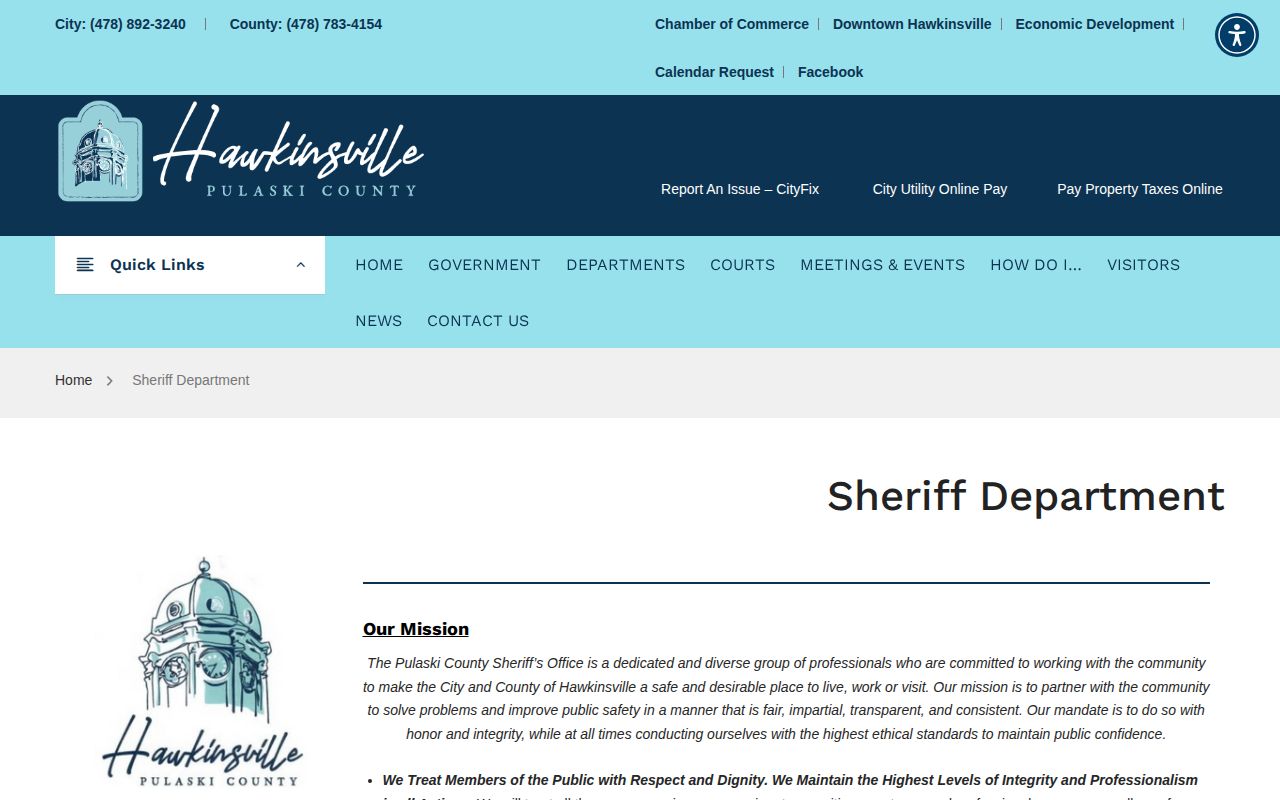
Before comparing any name or image, use the gateway to confirm a roster or feed actually belongs to Pulaski County, Georgia. Same-name counties cause plenty of confusion.
Pulaski Busted Booking Record Fields
A sheriff-linked card gives you more than a name. Current entries can list the arresting agency, days spent in jail, total bond, and a full charge table. Switch to the date-range view and you gain a status distinction that matters: released versus currently booked. Some gaps remain, though. The portal does not reliably publish a booking number, a next court date, a projected release date, or a final disposition. Treat a blank court or warrant field as a hole in the display. It is not proof that no case exists.
| Field | What the Pulaski display can show |
|---|---|
| Name | The name entered by the jail system. Compare spelling and other fields. |
| Status | Currently booked, or released in the arrest-date view. |
| Arrest date | The date used to place the event in the current or date-range search. |
| Agency | The arresting agency shown on the current-custody card when supplied. |
| Descriptors | Sex, height, weight, and a redacted address field. |
| Days in jail | A custody-system count, not a sentence or final outcome. |
| Bond | Total bond, or a momentary label such as not set or denied. |
| Charge rows | Warrant number, count, statute, description, misdemeanor or felony indicator, and court when entered. |
| Booking image | An image area that generally loads when a photograph is available. |
Every field here describes the jail's event record. None of it covers what a prosecutor later decided or what a court finally ordered. A bond value is not a fine, and "days in jail" is not a sentence. When a charge is marked felony or misdemeanor, that label reflects the booking classification at that moment. It predicts nothing about the outcome.
- Booking
- Jail intake after an arrest or other lawful custody event.
- Arraignment
- A court appearance where the charge and next court step are addressed.
- Disposition
- The court result, such as dismissal, plea, acquittal, or judgment.
- Record restriction
- A Georgia process that limits access to certain criminal-history information. It does not automatically erase every local or private copy.
Request Pulaski Busted Booking Photos
The county site posts no sheriff-specific open-records form, no records email, and no fee table with a promised turnaround. So pick up the phone. Call dispatch at (478) 783-1212 or the jail at (478) 783-4011, ask for the current Open Records Officer or records custodian, and confirm where a narrow request should go. That call is worth making. The right recipient can change.
Georgia's Open Records Act covers records an agency prepared, kept, or received in public business, subject to exemptions. It never forces the sheriff to build a new report or explain an empty field. A solid request targets an existing booking sheet and photograph tied to one person and one date. Include the arresting agency, a warrant or case number, and any alternate spelling you know. Skip unrelated sensitive identifiers.
- Confirm the current records custodian with dispatch or the jail before sending personal details.
- Ask for the existing booking sheet and booking photograph for a named event, with an electronic copy if available.
- Request the legal basis for any withholding and any reasonably segregable portion of the record.
- Ask for a cost estimate before charges accrue, then keep the request and response with the arrest date.
Pulaski County Sheriff’s Office
911 Dispatch
Highway 341 Bypass
Hawkinsville, GA 31036
Dispatch: (478) 783-1212
Jail: (478) 783-4011
Dispatch answers around the clock, 365 days a year. Ask for the Open Records Officer when you call.
The Attorney General's public-records guidance lays out a three-business-day response framework, lawful charges for search and redaction, and cost estimates. The first 15 minutes of searching are generally free. Copies on letter or legal paper are capped by statute at ten cents a page, and electronic-media fees can stack on top. Expect a required estimate above $25, with prepayment possible above $500 or when an earlier bill sits unpaid. Check the current procedure in the Georgia Open Records Act guidance before trusting an old form or fee sheet.
Being online and being retained are two different things. The current roster shifts each time custody changes, and the date search posts no oldest date or purge rule. For an older booking photo, ask the sheriff which record series governs it. Georgia's local public-safety schedule sets ten years after release for jail booking records and inmate case files, ten years after the last entry for jail registers, one year for daily incarceration lists, and 180 days for booking or holding-area video. Those are retention periods only. They promise nothing about any photo staying online.
Note: A records request seeks an existing record; it does not make the custodian create a new disposition, search result, or explanation.
Georgia Mugshot Rules and Removal
Georgia leans toward openness. The Open Records Act, O.C.G.A. §§ 50-18-70 through 50-18-77, opens most public records to anyone who asks, though certain material stays closed. Juvenile files, sealed or restricted records, victim details, medical facts, protected identifiers, and security-sensitive jail data can all be withheld or blacked out. Pulaski's own portal shows this in practice: the address field is visibly redacted on booking cards. A missing photo can stem from policy, a sync gap, legal protection, or a technical hiccup. It says nothing about whether an arrest happened.
Two state provisions trip people up because they sound alike. O.C.G.A. § 35-1-19 governs how an arresting agency may post booking photographs online and spells out permitted uses and release conditions. Separately, O.C.G.A. § 10-1-393.5 lets qualifying individuals demand removal, at no charge, from covered commercial booking-photo publishers once a proper request follows a qualifying case outcome. The Attorney General's mugshot websites information walks through the state process.
Neither law forces Pulaski County to wipe its own jail record. Think of the pieces as separate systems. One is what the government retains. Others are what a court restricts, what the sheriff displays, what a news outlet archives, and what a private site copied. Begin with the official disposition and the GBI record-restriction page. Arrests before July 1, 2013 go through the arresting agency using GBI's instructions and form. That agency may charge up to $50 to process the request. Newer arrests generally follow the prosecutor and disposition workflow. What qualifies you is the case outcome, not the photo's age.
Once a restriction or correction comes through, send the order to every custodian still showing the record. Ask each about their policy. A removed page can leave a stale search snippet behind. An outdated-content refresh tool fixes the snippet but cannot take down a live page. Skip paid middlemen, too. Georgia law may already require a covered publisher to handle the request for free. The official path needs no explanation service.
Publishers add one more layer. Mugshots.com posts a policy of free update or removal requests backed by restriction, sealing, a qualifying disposition, identity theft, or death documentation, and it asks for the record's site ID. Busted Newspaper and Recently Booked also publish free request routes for qualifying outcomes. Follow each publisher's current instructions to the letter. Keep copies of the request and proof. And remember one limit. Removing a private copy changes nothing at the sheriff's office or the courthouse.
For restriction questions, the Georgia Bureau of Investigation record-restriction page is the place to start. One caution, though: the GBI does not control every local or private copy of a record.
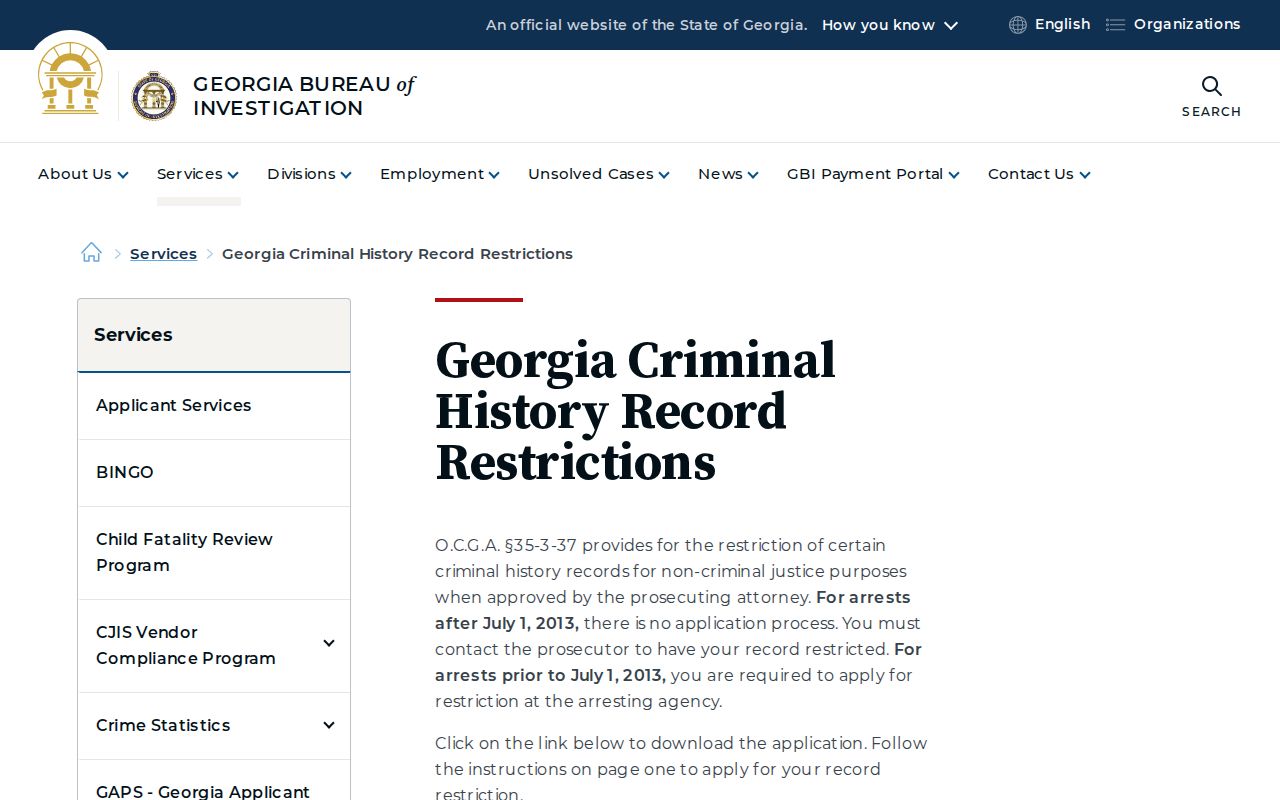
Even after a state record is restricted, a local jail display may need its own documented request to come down.
Find Pulaski County Busted Mugshots
Custody status decides which search to use. Someone just booked may not appear yet while the image synchronizes. Someone who bonded out can drop off Current Inmates yet still show up inside the arrest-date range. A sentenced state prisoner belongs in the GDC search, not the county roster. Immigration detainees and federal prisoners need a federal locator. A Pulaski booking feed will not carry them. Match the tool to the situation. Half the frustration disappears.
- Open the Sheriff Department gateway and follow its Inmate Information link.
- Use the rolling 24-hour page for a new booking, then the current roster for present county custody.
- Use the date-range search for a wider interval or a quick release, and read the released or currently booked status.
- Compare the date, agency, descriptors, warrant number, statute, and court. Never rely on a photo alone.
- Take the court field to the right clerk. If no web record appears, call the jail and request the existing record.
Timing is where most searches fail. The county's date-range view answers that problem locally. It can hold onto a result after the current roster has let it go. One quirk: the 24-hour feed sometimes returns nothing even while the portal runs fine. That blank screen means no entry came back at that moment. It is not evidence that the county saw no arrests or citations that day.
Where Pulaski Busted Photos Appear
Work the official sources in order, and pay attention to custody labels, not just photo policies. The county roster covers current jail custody. The 24-hour view captures recent entries, the date view can include people already released, and GDC handles state custody. Court records rarely carry the jail photograph. They do carry something a booking card never will: the outcome.
| Channel | Photo and custody scope | How to use it |
|---|---|---|
| Sheriff-linked current roster | Generally shows an image with a currently booked entry. | Use the optional name filter, pagination, and all card fields. |
| Last 24 Hours | Recent local jail bookings; an image appears when supplied. | Use the rolling window, not a midnight-to-midnight assumption. |
| Inmates by Arrest Date | Current and released statuses within the selected interval. | Choose both dates and narrow by name when needed. |
| Sheriff records request | An existing booking sheet or photo may be available subject to exemptions. | Call first for the Open Records Officer and current delivery path. |
| GDC Find an Offender | State corrections custody; a profile photo may be available. | Use for sentenced GDC custody, not a county booking today. |
| Court record | No booking-photo promise, but it carries filings and disposition. | Follow the court named in the charge row. |
| News and secondary archives | Photos vary. Coverage can be incomplete, stale, or not a booking photo. | Use only as a lead, then verify with the sheriff and court. |
Unofficial outlets fill the gaps. Mugshots.com hosts a confirmed Pulaski County, Georgia archive. Secondary Pulaski guides circulate online, and 41NBC runs a county-news stream. Treat all of them with care. A commercial archive can mix old entries, copied data, and missing outcomes. The local media page names the players and their caveats. The sheriff and the courts stay the primary record sources no matter what turns up elsewhere.
Busted and Booked in the Pulaski Roster
The sheriff-linked Current Inmates portal lists currently booked inmates across paginated pages. An optional name filter narrows things down. Each card pairs an image area with name, current status, sex, height, weight, a redacted address, arrest date, arresting agency, days in jail, total bond, and charge rows. For a booking image tied to present county custody, nothing local beats it.
| Search control | What it means |
|---|---|
| Name filter | Optional filter for the inmate name entered in the portal. |
| Pagination | More current cards may sit on later pages. |
| Current status | The person is shown as booked now, subject to portal lag. |
| Charge rows | Read warrant, count, statute, grade, description, and court together. |
- Start with the name filter, but scan the full result because names can repeat.
- Compare sex, height, weight, arrest date, and agency before treating a card as a match.
- Read the bond and charge rows as a snapshot, then verify the court result separately.
- Refresh later or call the jail if a very recent booking is missing.
The portal makes no promises about permanence. No sync interval is published. No retention horizon is stated either. An entry vanishes from the current view as soon as its custody label changes. The date-range page may keep a released entry visible, but no purge schedule appears anywhere. So treat the roster as an operational tool. It is not a real-time or permanent archive.
To see how the local card fits together, open the sheriff-linked current-custody portal and note how status, fields, charge rows, and the booking image area combine.
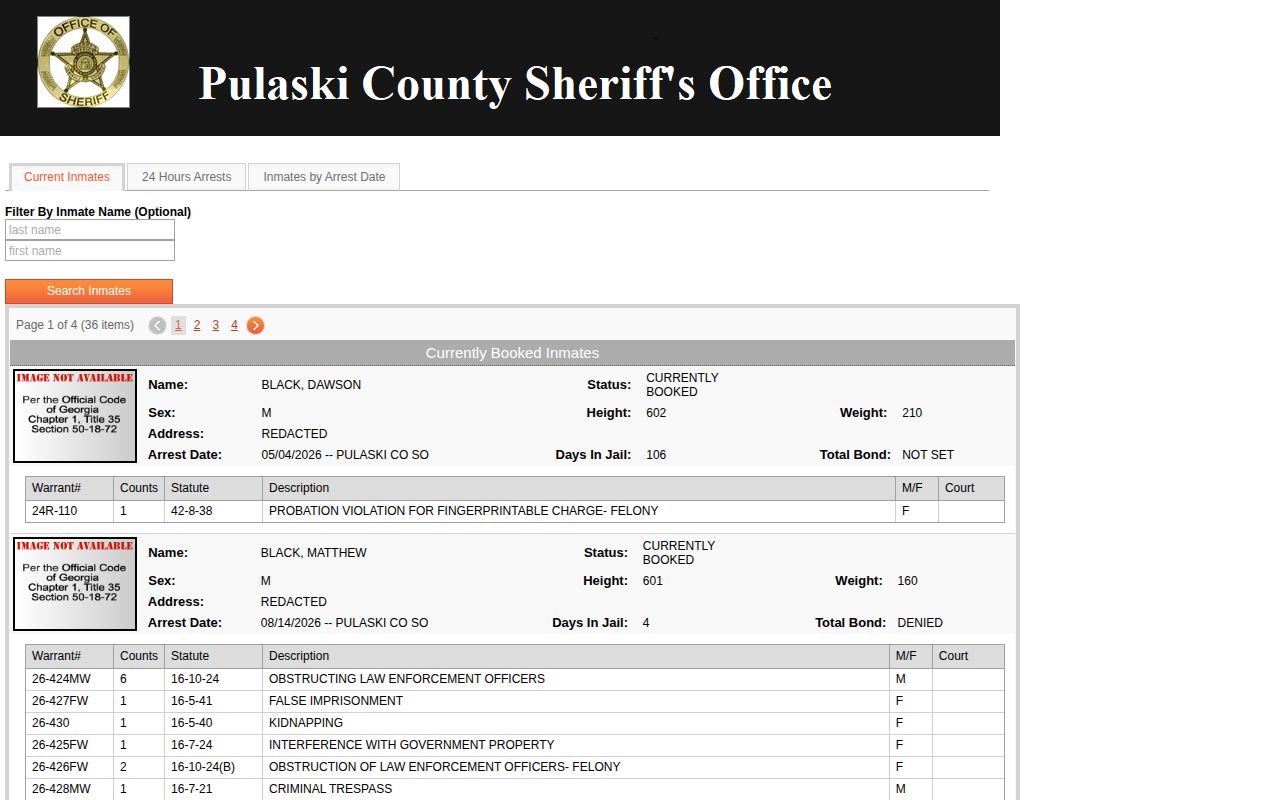
Read each card as a time-stamped jail event, then check it against the court record.
Busted Last Night: Pulaski Bookings
Pulaski County publishes two windows into recent bookings, and they serve different jobs. The first is Inmates Booked Last 24 Hours. Think of it as a same-day rolling feed. Some nights it comes back with "No data to display," which is normal for a working portal rather than a sign of trouble. It only shows people entered into the jail system, so citations, summonses, and arrests handled by another custodian will not appear. It is a booking feed, not a full incident log for the county.
Need to look back further? The Inmates by Arrest Date page is the better tool. Set your From and To dates, add a name if you have one, and search. Results include people who were released as well as those still booked, so it works well when someone bonded out quickly. For present custody, stick with the current roster instead.
The 24-hour booking feed runs on an exact rolling window, and an empty result can be a valid one. Not every night produces a page full of faces.
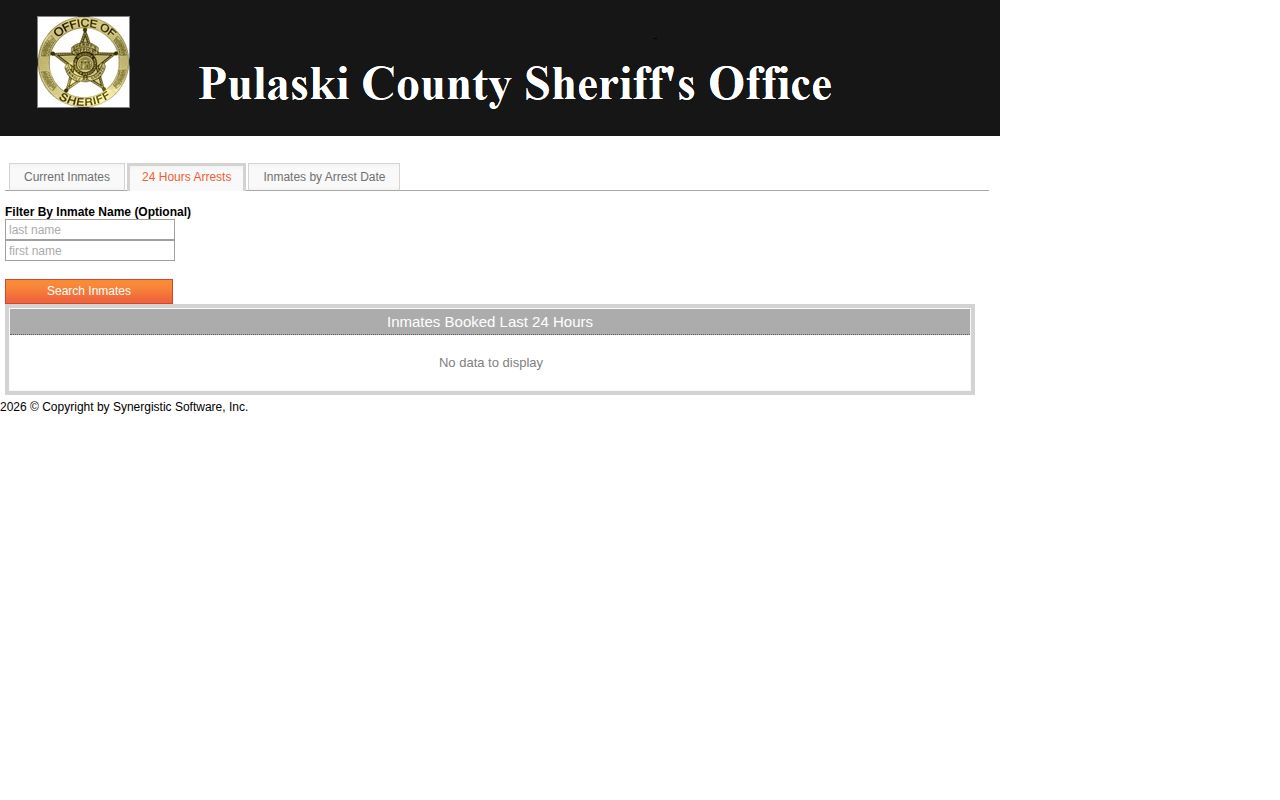
When the feed comes up empty, widen the net. Try the date-range tool first, then fall back to the records custodian if nothing surfaces.
There is no fixed weekly or 72-hour feed. A visitor can select seven days in the date-range tool, but that is a query you define yourself, not a report the county publishes. The portal promises no schedule, no archive depth, and no sync guarantee. Your best fallback chain is simple. Retry over a short range, call the jail, then file a narrow records request.
Busted to GDC: Offender Photos
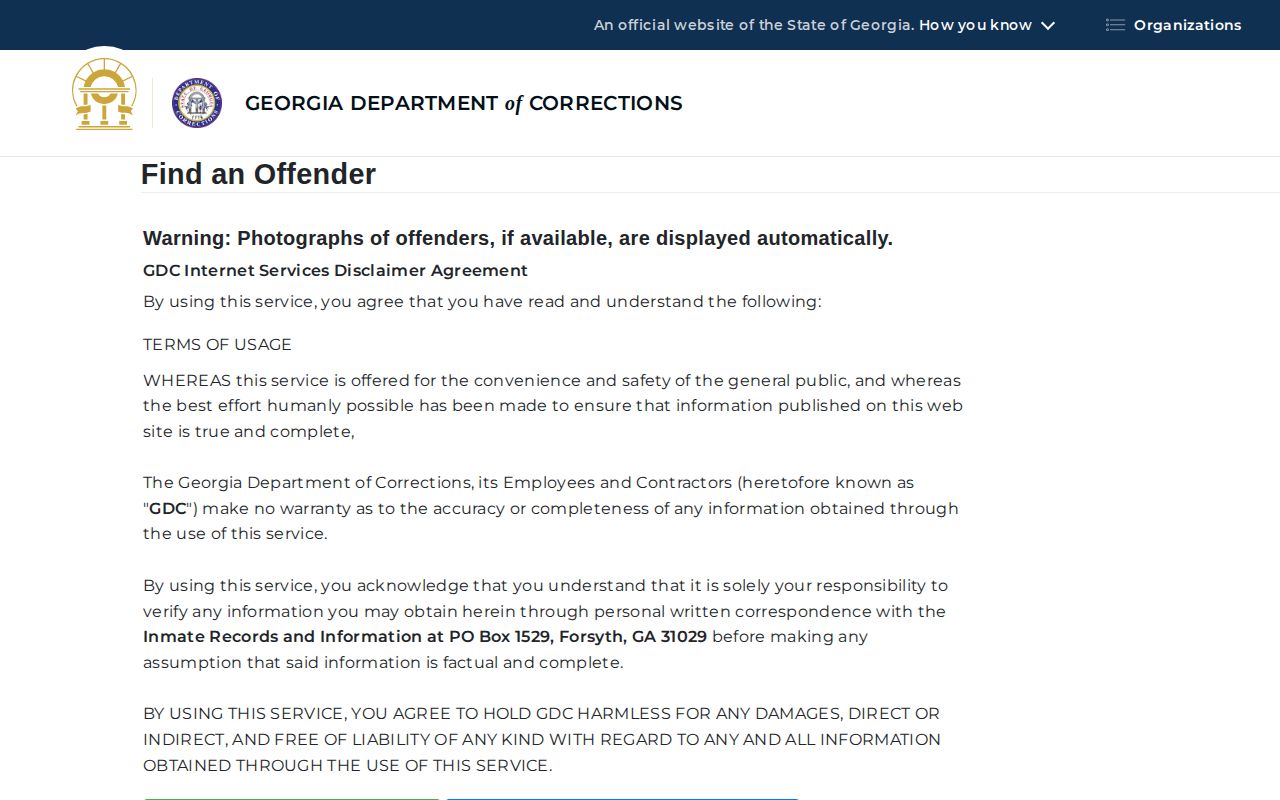
The state system is a different animal. The Georgia Department of Corrections Find an Offender service covers sentenced offenders and people under GDC supervision. It will not tell you who got booked in Pulaski County today. Plenty of arrests end in release, pretrial detention, or a local resolution. None of those paths ever touch the state system.
Searching it is straightforward. Fill in the fields the live form offers, including name and any GDC information you have. A match can return a GDC ID, custody status, institution or supervision details, sentence and offense data, and a photo where one exists. The agency says photos display automatically when available. Yet many were never uploaded, and completed First Offender Act cases stay unpublished. So a missing image does not mean a state record is missing too.
One more tip comes from the GDC FAQ. If an exact name search fails, try the first four letters of the last name and select all offenders. Name, physical description, GDC number, and case number are the fields that actually narrow things down. Still, a state result never becomes a Pulaski County booking record.
Once a person moves past the county jail, the GDC offender search form is the right route for state custody.
Hawkinsville sits inside Pulaski County. Pulaski State Prison sits inside Hawkinsville. That geography makes the distinction matter. A GDC profile never establishes a Pulaski County arrest on its own.
When a GDC photo or file is unavailable, try the department's Open Records Request route. Ask for an existing record. Include the full name, GDC ID, and a date range. Keep one thing in mind: GDC and the sheriff are separate custodians. A request to one will not pull the other agency's photograph.
Busted, Released, or State Custody
One person can pass through several record states. A channel that worked right after booking may fail after release, and a state-prison profile can surface long after the county card disappears. Read the table as a custody key.
| Custody state | Best record path | What the result proves |
|---|---|---|
| Just booked | Last 24 Hours feed, after synchronization. | An entry was entered into the county jail system, not a final case result. |
| Currently in county jail | Current Inmates roster. | The portal shows current booking status at the time checked. |
| Released after county booking | Arrest-date range or sheriff records request. | A booking event may remain searchable without current custody. |
| Sentenced to state custody | GDC Find an Offender. | A state corrections profile, not necessarily a Pulaski County booking photo. |
| Federal or immigration custody | BOP or ICE locator, with limits. | A separate federal or immigration custody result, not a county docket. |
Two federal tools cause confusion, so know their limits. The BOP locator does not publish booking photographs. The ICE locator is a custody tool with its own search and privacy limits, not a docket or a photo source. Nothing indicates that Pulaski County Jail holds an ICE detention contract or runs an ICE-specific roster. A detainer or an out-of-county hold is not evidence of one.
After a Pulaski County Bust
Booking starts the paper trail. It rarely ends it. A charge row may point to Magistrate, Probate, Municipal, or Superior Court, and some rows list no court at all. Bring the warrant number, arrest date, statute, and exact name spelling to the right clerk. Ask whether a case was filed, amended, dismissed, or resolved.
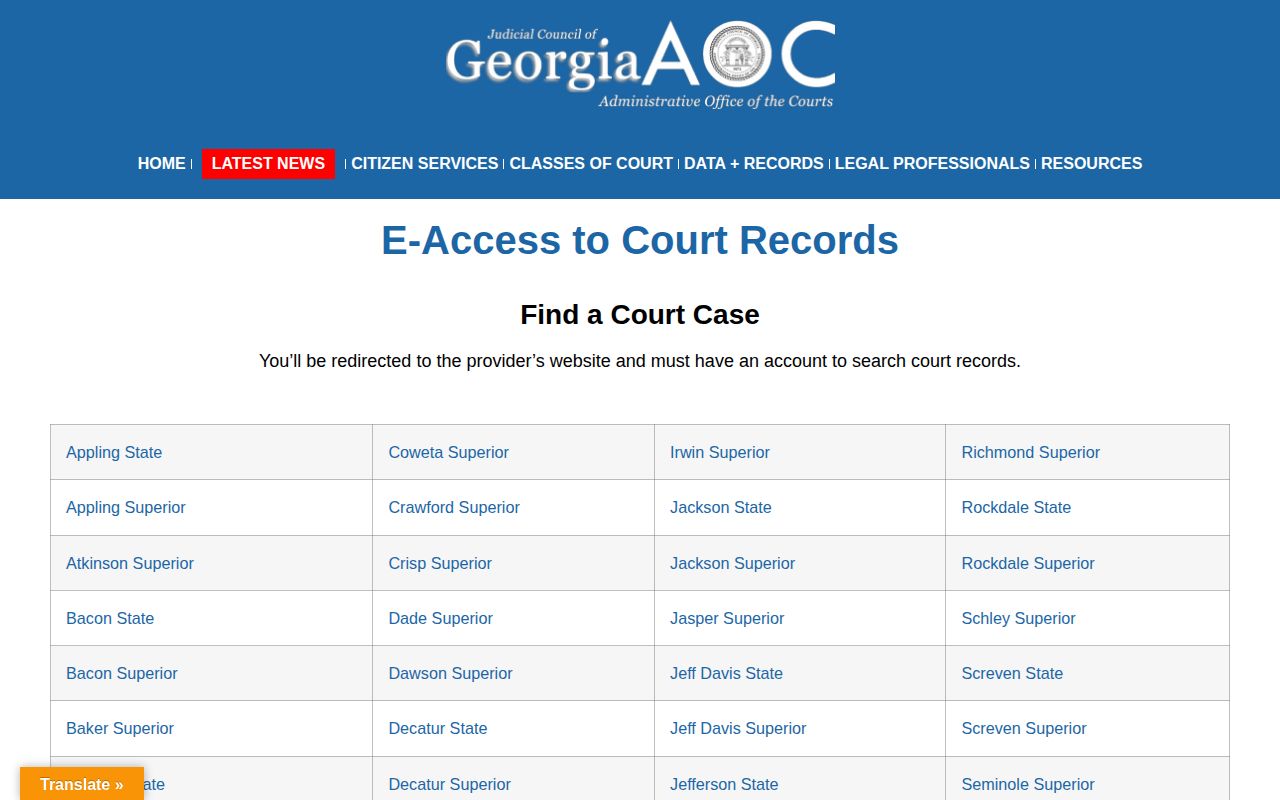
For statewide searching, start with Georgia Judicial Gateway eAccess. Confirm PeachCourt coverage and any document fees before relying on it. The Pulaski Superior Court clerk is listed at 141 Commerce Street, phone (478) 783-1911. The clerk's own site lists 350 Commerce Street instead, so call ahead before visiting or mailing anything time-sensitive. Hawkinsville Municipal Court handles arraignment and trial the same day, with court starting at 9:00 a.m. A booking row is only the beginning. The courthouse tells the rest of the story.
The official Georgia court-access gateway helps route a booking identifier to an actual court record, rather than treating the jail card as the final word.
Check the clerk and disposition after reading a Pulaski County booking allegation.
Which Court Handles a Pulaski Booking?
A booking row in Pulaski County can point to more than one court. You might see Magistrate, Probate, Hawkinsville Municipal, or Superior Court. That variety is why a single nationwide case search tends to fail here. Warrants and early criminal work land in Magistrate Court. City ordinance cases and traffic inside city limits go to Municipal Court. Probate Court turns up in some traffic-related rows, while felonies and most other serious matters belong to Superior Court.
What if the court field is empty? Start with the Superior Court clerk or the arresting agency. Bring the arrest date, the charge as written, and the warrant number. A blank field is not proof that nothing exists. Even when a docket index shows a hit, a clerk-certified copy of the filed outcome is the document that counts.
Released vs Currently Booked
Pulaski's date-range results come with two labels: "released" and "currently booked." The distinction trips people up. Someone can appear in a past-date search yet be long gone from the Current Inmates list. The reverse happens too. An inmate held for weeks may never surface in a fresh 24-hour feed.
Treat each status as a snapshot, not a permanent state. Releases, transfers, corrections, and syncing all change what the portal shows hour to hour. If a record truly matters, jot down the date and time you checked. Save the page URL. Then ask the sheriff's office for the underlying booking record when you need an official copy.
No Pulaski Sheriff Mugshot App
The Pulaski County Sheriff's Office has no official mobile app for jail bookings or arrest alerts. The web portal works fine on a phone. But calling it an app stretches the truth. Generic app directories deserve caution too. Several states have their own Pulaski County, and those listings often point elsewhere.
The dependable path is the sheriff's gateway and its three InterOp views. The joint county government site also links to state services like the GBI registry and Pardons and Paroles. Those are separate datasets, not live booking feeds. A sheriff's social media account is not a complete arrest log either. Posts can lag, get edited, or vanish entirely.
Pulaski Custody Alerts Through VINE
Georgia runs an official victim-notification system called VINE. Eligible users can enroll for custody status alerts. It is not a mugshot feed. It is not a court docket. Enrollment steps, participating agencies, and current instructions live with the Georgia victim-information program.
If a release or transfer alert arrives and the case outcome matters, verify it with the clerk of court. The Pulaski roster has no county-level subscription of its own. VINE simply serves a different purpose than the last-24-hours booking page.
Pulaski State Prison and County Records
Pulaski State Prison sits in Hawkinsville. That shared address creates confusion in search results. County jail records cover local bookings and county custody, current or released. GDC profiles describe state custody or supervision after a sentence. The location name alone does not make the two custodians interchangeable.
When taking notes or filing a request, record the agency, custody status, arrest date, and facility type. A GDC photograph may come from an entirely different corrections process and date. And a county booking photo proves nothing about state incarceration.
Pulaski’s Booking Photo Limits
The official-vendor portal generally shows a booking image when one exists. That is the honest local statement, because no Pulaski policy guarantees that every person gets photographed, that images post immediately, or that photos stay online for a fixed span. Intake timing, syncing gaps, juvenile status, restrictions, or technical problems can all affect what appears.
Missing or outdated photo? Contact the records custodian rather than guessing. An absent image signals nothing about a case. Never rehost a photograph pulled from the roster.
Pulaski Records Fees Before a Request
The sheriff's page publishes dispatch and jail phone numbers. But it lists no records-unit line, no request form, no email, no fee schedule, and no booking-photo price. That gap is itself guidance. Call first. Ask for the Open Records Officer, keep the request narrow, and insist on a written estimate before costs build up.
State law sets the framework for search time, redaction, copying, and electronic media. The local office does the actual math. Hold onto the estimate, and question the legal basis for any field withheld. Do not assume a free photo or a fixed turnaround the county has never promised.
Pulaski Jail Reports and Booking Records
The sheriff's page connects to two different tools: a quarterly Jail Report and the person-level portal. The report is statistical. The roster is individual. Each answers a different question, and blending them leads to bad conclusions.
Read the period and definitions before quoting any number. The sheriff's first-quarter 2025 Jail Report is an operational source, not a people finder. Admission counts, average population, and release totals never equal the number of unique individuals arrested. Use the report for county-wide context; use the portal, the courts, or the records custodian for one person's booking event.
Note: A county statistic can describe jail operations without identifying who was booked or what any individual case decided.
Older Pulaski County Booking Records
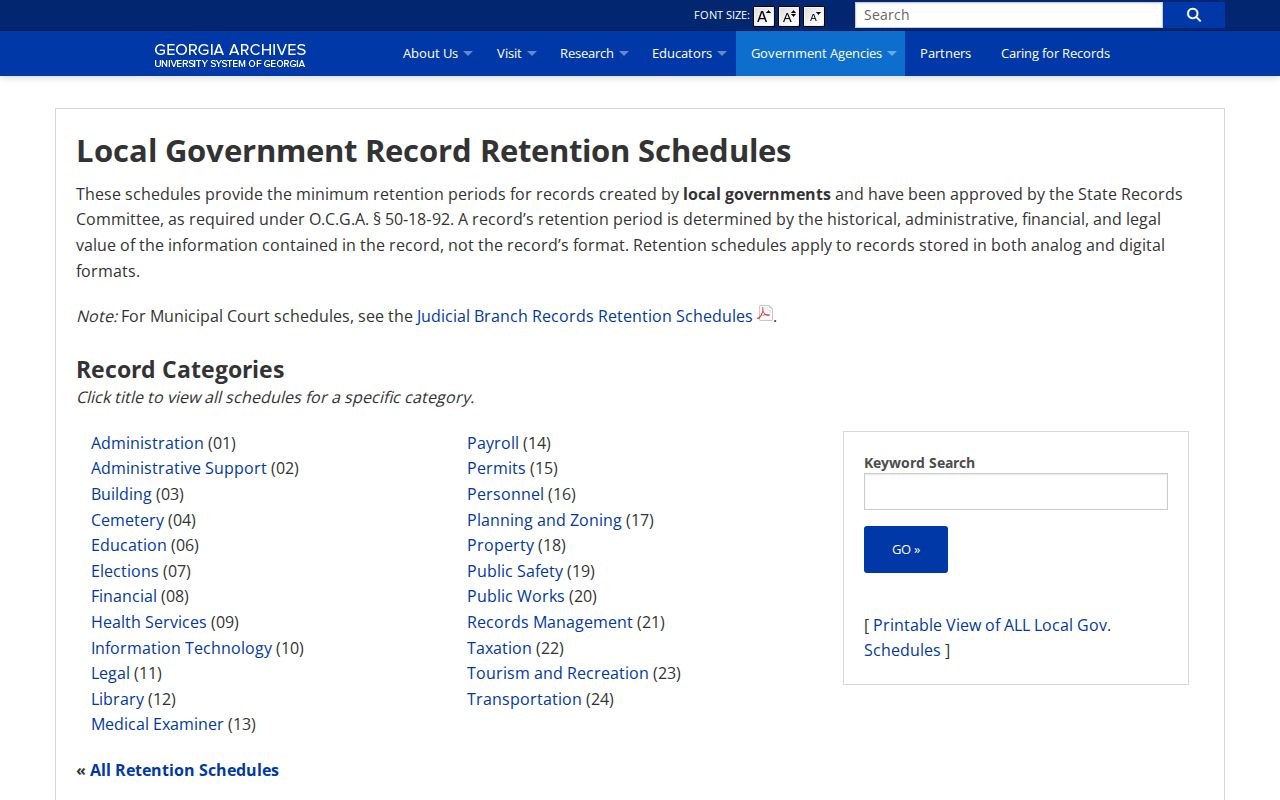
How long does Pulaski County keep its jail paperwork? The answer comes from state rules, not guesswork. Under the Georgia Archives schedule, booking records and inmate case files are kept ten years after release, and jail registers last ten years after the final entry. Daily incarceration lists get one year. Booking or holding-area video is kept just 180 days. Note that sealing a record changes who can see it, not necessarily how long the county keeps it.
Want an older booking sheet or photo? Call the sheriff first. Ask whether the record still exists, which series it falls under, and if it was thrown out or moved, where it went and when. Court papers live with the clerk of the right court. Anything from state prison goes through GDC's records process. The Georgia Archives retention schedules hold the official timeline. One caution: don't send a fresh booking request to the Archives, since recent material stays with the sheriff.
The Georgia Archives local-government schedule sorts booking records, registers, daily lists, and video into separate series, each with its own retention clock.
With historical material, provenance counts. Knowing which office first held a record can matter as much as the photo or file itself.
Busted Mugshots by Pulaski City
Hawkinsville is the whole municipal story here. It holds the Pulaski County seat. It is also this county's only city page in the CITY MAP. Hartford and Finleyson show up on the map as communities. Neither one is an incorporated city. Hawkinsville arrests run through the consolidated sheriff and county jail, so the same portal views cover them. That means the current roster, the 24-hour view, and date-range searches all work for city bookings too.
- Hawkinsville Busted Mugshots covers the city’s sheriff-policed booking path, absence of a separate police blotter, county roster, court routing, and local news coverage.
City-level detail lives on the Hawkinsville page. Any arrest booked at the Pulaski County Jail, though, still runs through the county-wide roster and the records-request process described here.